
![Out of gauge container: Top container types [+ 2024 guide to best prices]](/_next/image?url=%2Fblog%2Fout-of-gauge-container-featured.jpg&w=1920&q=75)
Wondering which out of gauge (OOG) container type is suitable for your tricky cargo? Don’t fret! This blog is your go-to guide to OOG container types, and how to transport your shipments safely and effectively. Plus, get OOG containers at the best price in 2500+ locations on schedule a demo.
If you’ve got clients with special shipments, OOG containers are the solution you’re looking for. Extra tall cargo? You’ll need an open top. Oversized or oddly-shaped shipments? A flat rack is your answer. Luckily, it’s easy to find the container type and size you need on Container xChange.
So who are we? Container xChange is an online marketplace for container trading and container leasing of all types and sizes. We’ve got 50,000+ containers available in over 2,500 locations worldwide. On our platform, you can find the containers you need for your clients, at prices that suit your budget.
If you’re curious about how our marketplace works, why not check out our trading search right now? You’ll see just how simple it is to find OOG containers at negotiable prices. Select your location and the container type you’re after, then hit ‘search’ to browse available offers today.
If you don’t know what container type you need for your goods, don’t worry. Keep reading for all you need to know.
What is out of gauge cargo?
When we talk about out of gauge (OOG) cargo, we’re referring to cargo that exceeds the Standard Shipping Container Dimensions. Standard dry containers come in three main sizes: 20ft, 40ft and 40ft HC (high cube). Any cargo that can’t fit into a standard container falls into the OOG category.
So what size and weight constitutes out of gauge cargo? Anything that exceeds the following dimensions:
| Size | 20ft | 40ft | 40ft HC |
| Internal length | 5.9m / 19.4ft | 12.03m / 39.5ft | 12.03m / 39.5ft |
| Internal width | 2.35m / 7.8ft | 2.4m / 7.9ft | 2.35m / 7.8ft |
| Height | 2.39m / 7.9ft | 2.39m / 7.9ft | 2.70m / 8.10ft |
| Cubic capacity | 1,172 cu ft / 33.2 cu m | 2,389 cu ft / 67,7 cu m | 2,694.5 cu ft / 76.3 cu m |
| Payload capacity | 55,126.9 lbs / 25,000 kg | 61,200 lbs / 27,600 kg | 63,052 lbs / 28,000 kg |
| Tare weight | 5,071.5 lbs / 2,300 kg | 8,268.8 lbs / 3,750 kg | 8,598 lbs / 3,900 kg |
Want to learn more about standard shipping containers, their uses and benefits? standard shipping containers
Types of out of gauge cargo
Now we know that OOG cargo is pretty large and heavy. But what about the types of goods that constitute out of gauge? Here are a few common examples:
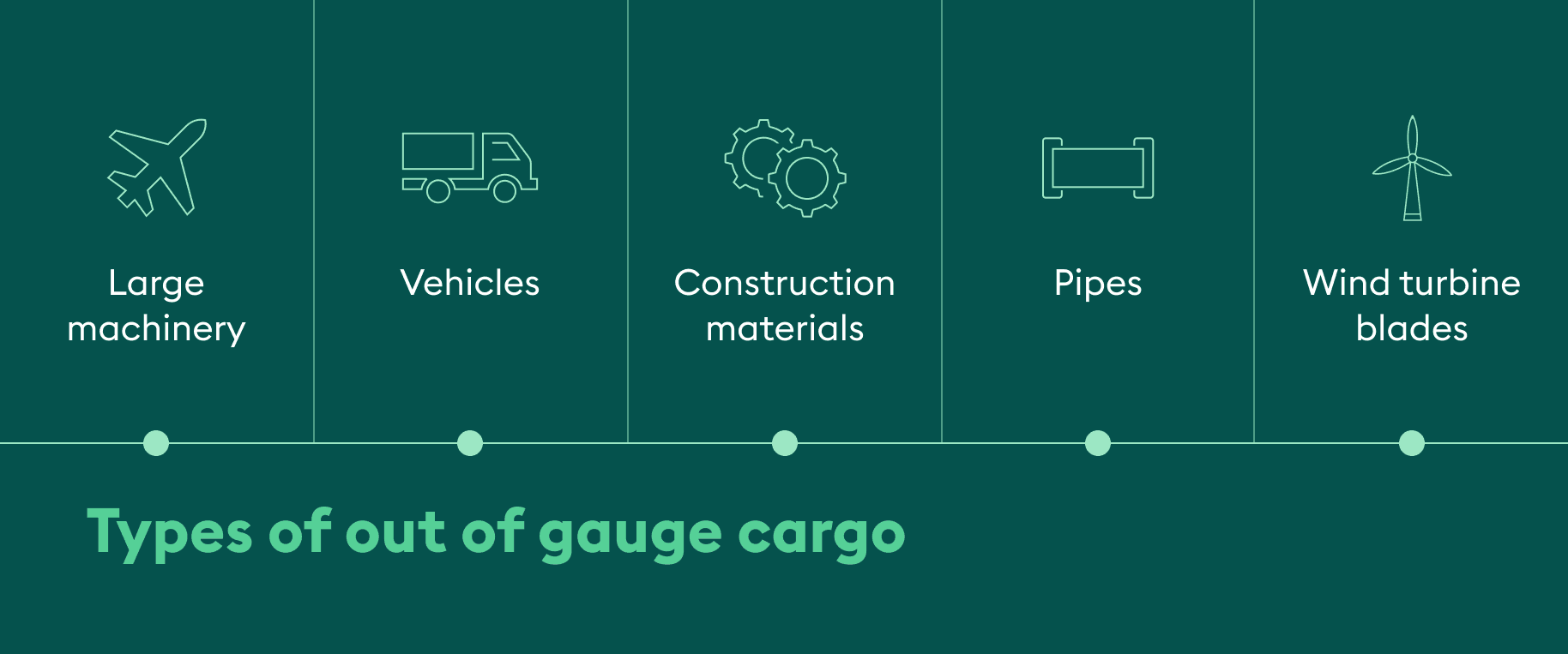
We’ll learn about which containers are best suited for each type of cargo in the following sections.
Out of gauge container types and their dimensions
When looking for containers for your OOG cargo, it’s important to compare the dimensions and payload capacity against the container type you’re after, to ensure your shipment will fit.
Let’s take a look at the three main out of gauge container types now, plus their uses and dimensions.
Flat rack container
flat rack containers is basically a container without a roof or walls on its long ends. This special container type is ideal for large, tall or oversized cargo.
Your goods are secured on a flat rack using lashing rings, which are wrapped tightly around the container walls and cargo, keeping it safe during transport. There are various types of lifting equipment that can be used to load cargo onto a flat rack. This includes cranes, reach stackers, straddle carriers and loaders.
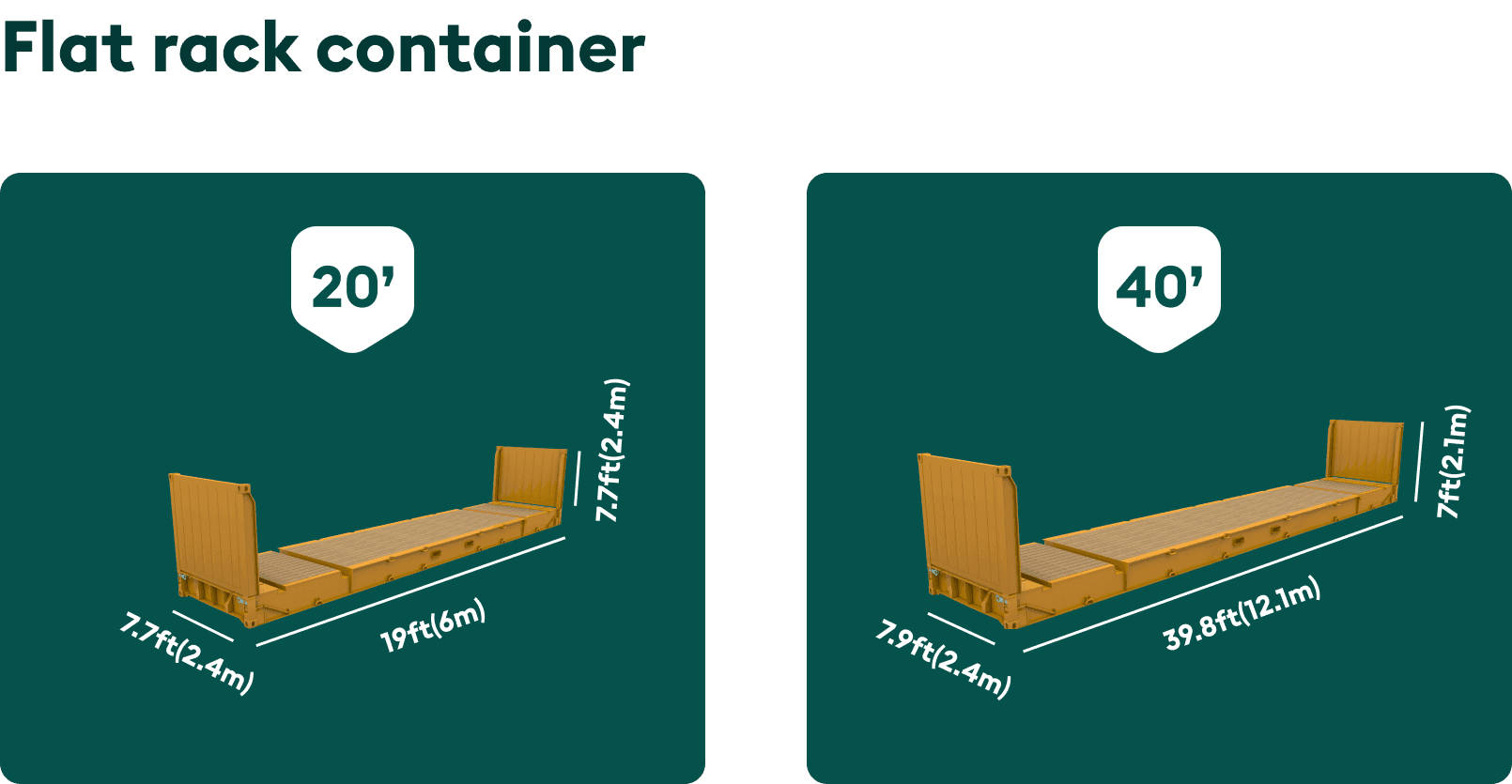
Flat racks are suitable for transporting:
- Construction equipment such as cranes, excavators, and bulldozers
- Large industrial machinery like compressors, generators, and turbines
- Cars, trucks, and buses
- Yachts, sailboats and motorboats
- Pipes and other extra-long cargo
And here’s the weight and capacity of 20ft and 40ft flat racks:
| Dimensions | 20ft | 40ft |
| Tare weight | 2,360kg / 5203.8 lbs | 5,000kg / 11,025 lbs |
| Payload capacity | 30,140 kg / 66,458.7 lbs | 40,000kg / 88,200 lbs |
| Cubic capacity | 32.7 m3 / 1,154.3 cu ft | 62.2 m3 / 2,195.7 cu ft |
Open top container
Open Top Container are standard containers without a fixed steel roof. This container type usually comes with a tarpaulin sheet that can be removed during loading and unloading, and fitted during transport. This tarpaulin helps to protect OOG cargo from wind, rain and harsh sun.
To load cargo into an open top container, a crane is usually utilized to add or remove goods from the top. Other lifting equipment can also be used, including a forklift or front-end loader, depending on the cargo. Lashing rings then secure the cargo if needed, keeping shipments safe and holding them in place during transport.
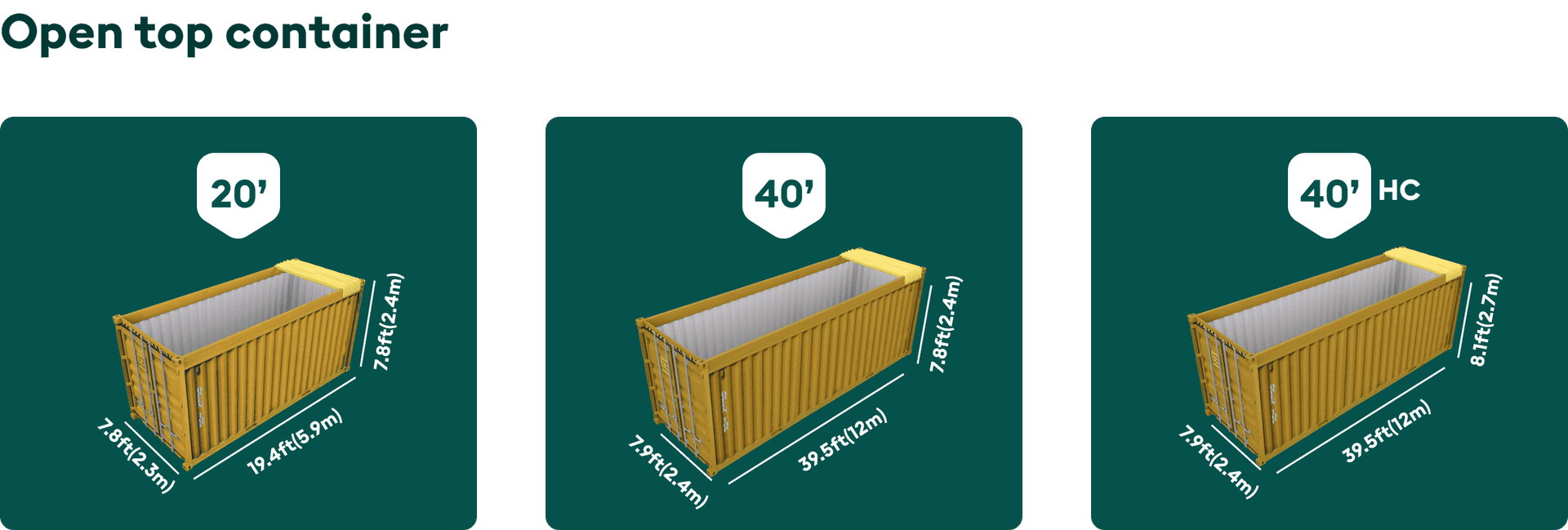
Open tops are perfect for oversized machinery, construction equipment, vehicles, boats, and wood logs. They’re also useful on construction sites to store building materials that need to be accessed quickly and frequently.
Check out the weight and capacity of the 20ft, 40ft and 40ft open top container below, to see which size works for your shipment:
| Dimensions | 20ft | 40ft | 40ft HC |
| Tare weight | 2,260kg / 5,982 lbs | 3,980kg / 8,774 lbs | 4,250kg / 9,370 lbs |
| Payload capacity | 28,220 kg / 62,214 lbs | 26,500kg / 58,422 lbs | 28,250kg / 62,281 lbs |
| Cubic capacity | 32.7 m3 / 1,155 cu ft | 66.7 m3 / 2,356 cu ft | 74.9 m3 / 2,645 cu ft |
Hard top container
Hard Top Container is similar to an open top, except that it has a hard, removable steel roof. Like the open top, this container type is perfect for loading cargo from the top or transporting goods that are too tall, long or large for a standard container.
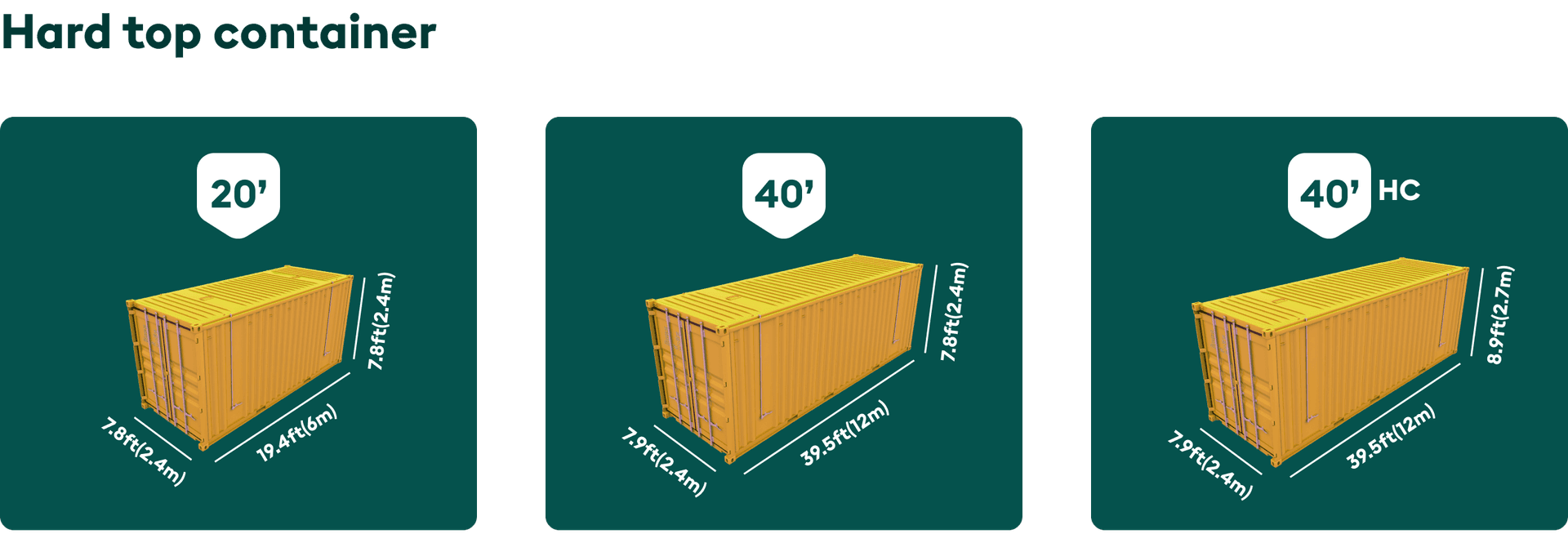
Hard tops are more suited for high-value cargo than open tops. This is because the hard roof provides better security than the tarpaulin of the open top. Keep this in mind when deciding between an open top and a hard top container. Like with an open top, a crane, forklift or front-end loader can be used to load cargo.
Have a look at the weight and capacity of hard tops of different sizes below, to see which one works for you:
| Dimensions | 20ft | 40ft | 40ft HC |
| Tare weight | 2,260kg / 5,982 lbs | 3,980kg / 8,774 lbs | 5,200 kg / 11,470 lbs |
| Payload capacity | 28,220 kg / 62,214 lbs | 26,500kg / 58,422 lbs | 28,600 kg / 63,052 lbs |
| Cubic capacity | 32.7 m3 / 1,155 cu ft | 66.7 m3 / 2,356 cu ft | 76.3 m3 / 2,694 ft3 |
Interested in the flat rack, open top or hard top containers for your OOG cargo? You can find both new and used OOG containers on xChange, at prices you’ll love. Get the containers you want in the locations you need right away by clicking below now.

How much do out of gauge containers cost?
So now that you know all about out of gauge containers and cargo, you might be wondering how much you’ll have to shell out for these container types. This is the section where we give you prices, so that you can get an idea of how much you’ll need to set aside.
Check out the prices of cargo-worthy (used) 40ft hard tops, open tops and flat rack containers in popular locations around the globe below:
Price of 40ft flat rack container
| Location | Price (USD) |
| USA | $2,104 |
| India | $3,375 |
| Europe | $2,873 |
| China | $4,058 |
Price of 40ft open top container
| Location | Price (USD) |
| USA | $4,333 |
| India | $6,300 |
| Europe | $7,152 |
| China | $4,853 |
Price of 40ft hard top container
| Location | Price (USD) |
| USA | $6,150 |
| India | – |
| Europe | $4,106 |
| China | – |
Want to know the prices of more container types and sizes? schedule a demo What’s more, all offers you see on the platform are completely negotiable. Yes, you heard that right. You can speak directly to sellers to decide on a price that everyone’s happy with. So what are you waiting for, get searching for the containers you need right away!
If the above container prices don’t suit your budget, don’t worry. container leasing at the best rates on Container xChange. Leasing containers gives you flexibility and freedom, without the hefty purchase costs. Learn all about the SOC containers
Challenges of transporting out of gauge cargo
Out of gauge cargo comes with its own set of challenges. Here are some of the biggest potential obstacles to be aware of when shipping OOG cargo:
Damage during loading and unloading: The irregular shape and size of OOG cargo can make it tricky to load and unload cargo safely. If not handled properly, the cargo or containers could get damaged, incurring additional costs. Container Damage
Toppling or shifting during shipping: OOG cargo is more prone to toppling or shifting during shipping due to its irregular shape, weight and size. This can cause damage to the cargo, container, or even the transport vehicle.
Ensure that the cargo is properly secured and balanced during transportation to prevent shifting or damage. Use appropriate Container Loading, such as tie-downs, chains, or straps, and regularly check the cargo during transit. You can also use logs or other materials to fill the gaps, in order to prevent sliding.
Weather-related risks: OOG cargo may also be more vulnerable to weather-related risks, such as strong winds or heavy rain. This is because it’s often exposed directly to the elements. If possible, cover OOG cargo with tarpaulin sheets to prevent unnecessary damage.
Now that we know some of the challenges, let’s find out how you can to be 100% prepared in order to avoid hurdles before, during or after moving your OOG cargo.

What to keep in mind when transporting cargo in an out of gauge container
We know what the risks are, now let’s make sure you’re completely prepared, with the following checklist:
Height restrictions: OOG cargo may exceed the height restrictions of certain transport routes, such as bridges and tunnels. It’s important to take this into account and plan accordingly in order to avoid delays and fines. Also make sure that you choose a trucking company that can safely and legally transport your cargo, and has all of the correct licenses.
Regulatory compliance: Out of gauge cargo may require special permits and compliances, which can be time-consuming and add on additional costs. Make sure you find out exactly what documents and permits are required in the areas you’re moving goods, or you could be looking at some hefty fines.
Insurance and liability: OOG cargo is typically more valuable than standard cargo, which means that it may require container insurance. This can increase transportation costs and might mean additional paperwork and legal considerations as well. However, if something goes wrong, you won’t regret having the cover.
Communication: It’s important to maintain open communication with all parties involved in the transportation of OOG cargo, including the shipper, carrier, and consignee. Keep them informed of any issues or delays as they come up and work together to resolve them.
And you’re all set! Let’s look at the final steps to getting OOG containers below.
Get containers for your out of gauge cargo on Container xChange
So you’ve decided on the container type you’ll need for your OOG cargo. What’s next? Signing up as a member on Container xChange to find the best container deals, of course.
Here are just some of the benefits you’ll enjoy once you join our Container xChange
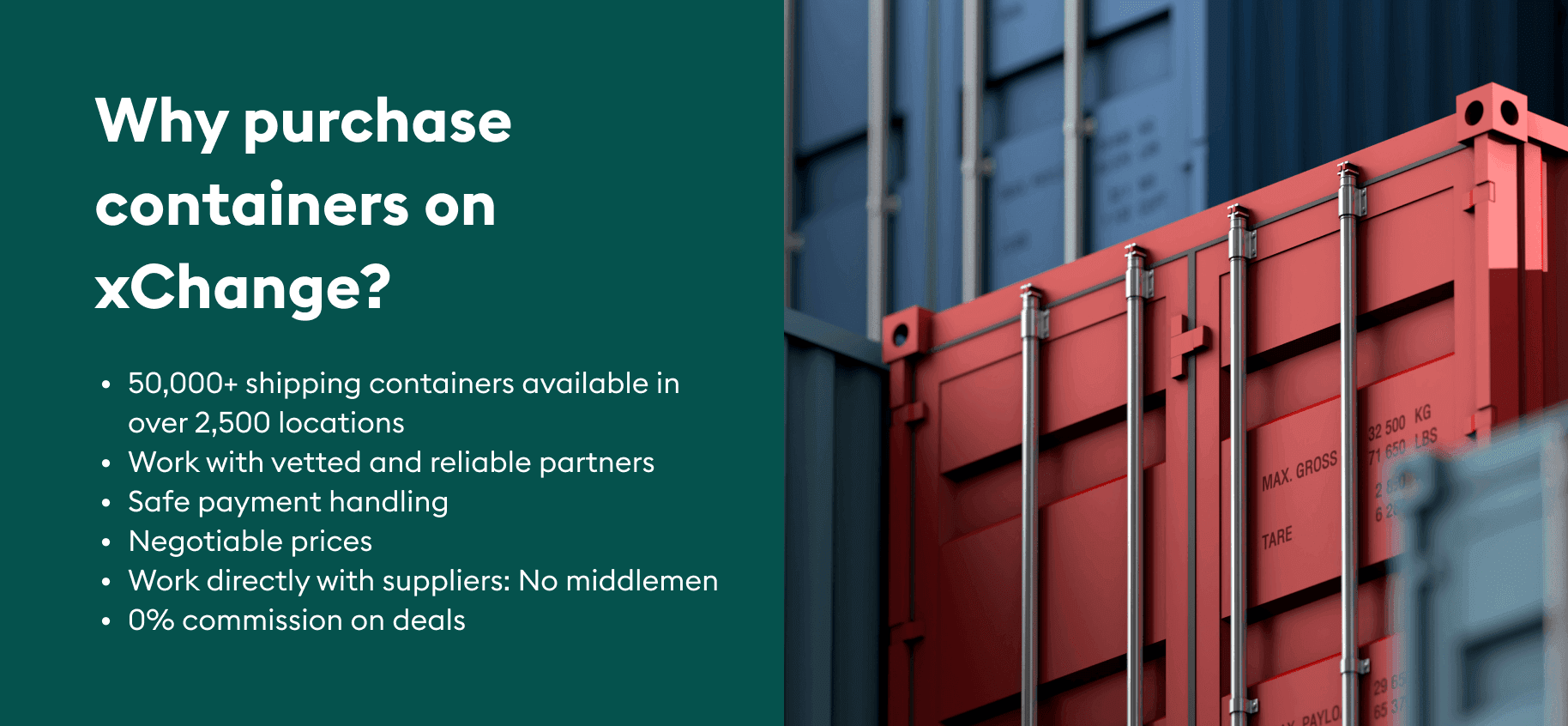
So how do you get started?
Browse container offers: Once you’ve signed up, navigate over to the trading search, type in your requirements, and start browsing available offers right away. The best part? You can compare the prices of multiple options at the same time, to make sure you’re getting the best deal out there.
Negotiate the price: Once you’ve found an offer that suits you, negotiate the price directly with the seller and agree to all terms and conditions right on the platform. No back-and-forth, no middleman.
Make safe payments: You’ve agreed on a price, and you’re happy with all of the finer details. Great! Then it’s time to sign the deal and make the payment. Luckily, all payments on xChange are 100% secure with our learn more about xChange Wallet.
Ready to buy OOG containers in the locations you need, at a price that suits your budget? You’re in the right place. Click below to set up your free demo with our expert team right away, and learn all about getting the ideal containers for your OOG needs today.

What is an out of gauge container?
An out of gauge (OOG) container is a container suitable for transporting cargo that won’t fit in a standard dry container. This includes open tops, flat racks and hard tops. Specialized lifting equipment is usually required to load and unload OOG cargo.
What does it mean when cargo is out of gauge?
Out of gauge cargo is cargo that doesn’t fit into a standard dry container. This includes large, heavy and oddly-shaped shipments. Oversized machinery, large vehicles and boats, construction materials, pipes and wind turbine blades all fit into the OOG category.
What does OOG mean in the shipping industry?
OOG stands for ‘out of gauge’ cargo. This means any cargo that’s too heavy or large to fit in a standard dry container, and has to be transported loose (break bulk), or in a flat rack, hard top or open top container.